

AI FOR ENVIRONMENT SUSTAINABILITY
- PANCHTATVA The Environment Society
- Nov 27, 2022
- 6 min read

By Kajal Khardia | November 27, 2022
INTRODUCTION
The growth of the AI industry, especially, AI for environmental protection has introduced solutions that can solve major environmental concerns. The ecological challenges are increasing by the day and include global warming, animal endangerment, carbon emission, disease containment, air and water pollution (Orion Market Research, 2019). The advent of AI can lead to the efficient use of renewable sources of energy, such as solar energy, biogas, and wind energy. Besides, AI for environmental protection can include machine learning for protecting the oceans, ocean mining, fishing, and managing marine diseases. In addition, AI can be used for environmental management problems. This includes expert systems advising emergency response teams about handling the industrial incidences, systems to handle hazardous waste, modelling water quality, and other environmental engineering software. The AI systems are essential for environmental protection because they can process large amounts of information and deduct valuable conclusions. Air Pollution According to MedlinePlus (n.d.), air pollution can be defined as the airborne collection and combination of solid particles and gasses. The pollutants that are emitted into the air can be hazardous to the well-being of humans and the environment. In most cases, air pollution is initiated by energy production and usage. For instance, more than people in the world depend on the polluting sources of energy, such as coal and kerosene. Other sources of pollution include car emissions, industrial gas emissions from factories, dust from human activities, and agricultural waste incineration, which can result in the collection of the harmful particles in the air. In particular, the accumulation of pollutant gasses can destroy the Ozone layer, which shields people from the detrimental effects of the ultraviolet rays of the sun.
EFFORTS OF MICROSOFT
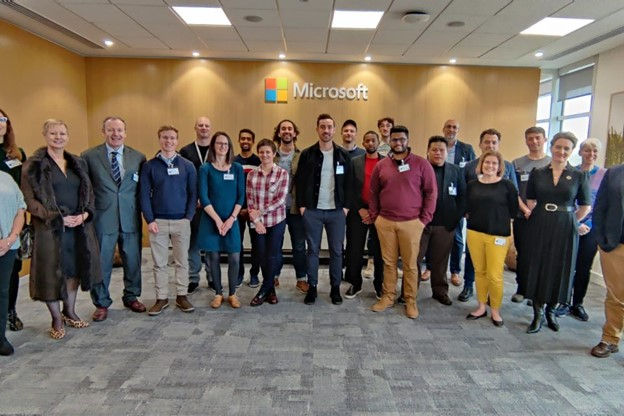
The AI for Environmental Sustainability Accelerator is one of the many programmes run by Microsoft wherein promising startups are offered technical support, through which they can develop their product.
Through this programme, selected companies have the advantage of relishing the various facilities that Microsoft stores, including their resources and other technologies to kick-start their product development. Guidance and advice for product development are provided by the UK’s Met Office.
WHY THE NEED FOR AI?
When our planet is facing the harsh consequences of human activities so it only makes sense to use something that is made entirely by humans to reverse all the harm caused. Not just this, Artificial Intelligence has proved to be one of the best experiments of mankind in the technological industry. Time and again AI has proved its vital importance in every sector and it is considered of crucial importance in the field of environmental sustainability as well, hence, the upliftment of Artificial Intelligence.
EXPANSION OF START-UPS
The programme helped many start-ups to venture into the world of consumers thus, opening new doors for commercialisation.
"The programme has really helped us to accelerate our growth and scale the business from two employees at the start to nine at graduation,” said Freddie Lintell, Chief Executive Officer of Reewild, which helps food and drinks manufacturers measure and communicate the carbon footprint of their products. “We’ve worked closely with some of the best minds in the field of AI to build something entirely original that is garnering more and more interest from the industry.” For Edinburgh-based Scrapp, whose app offers guidance on how to recycle different consumer products properly, inclusion in the accelerator programme led to a business plan pivot. “We had been focused on helping town and city councils in their recycling processes but Microsoft suggested this would also be suited to campuses, such as offices and universities”, said co-founder Evan Gwynne Davies. “Within two days of our new approach, our first corporate client reached out to us to use Scrapp on its office campus. The accelerator completely changed the trajectory of our business.” Carbon-accounting software maker CO2Analysis said its selection had produced immediate and direct benefits to the environment, helping clients save an additional 6 million tonnes of carbon dioxide, the greenhouse gas chiefly responsible for global warming.
SUSTAINABILITY
•LEADING THE WAY IN DECARBONISATION Reaching climate targets will depend on a number of different approaches and solutions working together. One example of this is capturing carbon for re-use. Carbon capture and utilization (CCU), is a key component of the decarbonisation puzzle and SABIC is leading the way. •REUSABLE CUTLERY MADE FROM NATURE Today, one of the biggest challenge the food industry is facing is to reduce the environmental impact and the use of fossil-based resources for single-use cutlery, and enable full recyclability and compliance with the stringent food packaging industry standards without affecting the quality. •RECYCLED MATERIALS THAT KEEP ON PROTECTING OUR HEALTH AND THE PLANET SABIC have teamed up with Fibertex Personal Care, one of the world’s largest manufacturers of spunbond nonwovens for the hygiene industry. The collaboration resulted in the world’s first nonwovens range based on recycled plastics. •ACCELERATING ELECTRIFICATION WILL ULTIMATELY ACCELERATE A SUSTAINABLE FUTURE Vehicle electrification has become a huge part of the move towards a more sustainable future, but it faces numerous challenges to increase adoption. •COLLABORATION. IT’S CREATING SUSTAINABLE FUTURES. Our partnerships are helping to cut greenhouse gases, reduce waste and educate young people about sustainability. •TRANSFORMING WASTE CO2 INTO FERTILIZER At our CO2 capture and purification mega-plant, we can reuse up to half a million tons of waste emissions that would otherwise be emitted into the atmosphere. A significant amount of the captured CO2 is used to produce urea, a common nitrogen-based agri-nutrient for more plentiful harvests. •LESS FOOD WASTE Over a third of the world’s food is lost between farm and fork. Innovative packaging solutions from SABIC are helping global food companies and consumers reduce food waste. Multi-layer pouch packaging made with SABIC® polyolefins is giving food longer shelf life, preventing leakage in a lightweight solution with high sealing integrity.
SOME MAJOR EXAMPLES

YesMake, an organisation that develops beautiful public infrastructure out of repurposed materials, was one of the more unusual grads. Because of Microsoft's guidance, co-Founder Morgan da Silva and his team were able to focus their marketing and branding to better reflect the sustainable mindset behind their activities. It also spurred the idea for an app that might manage the efficient collecting and productive use of trees cut down every day in London. “The Accelerator helped us define our vision and be able to effectively communicate and explain what we do. As a result, our social enterprise is growing and developing much quicker than it would have without the programme,” da Silva said. The Met Office of the United Kingdom, which has a connection with Microsoft as a provider of world-class supercomputing power that will assist them in pushing weather and climate forecasting to the next level. It will enable a paradigm shift in our knowledge and understanding of climate science and the mitigation required to mitigate the effects of global warming during the next decade. Emily Wallace, a Met Office Science Manager working in the provision of climate and weather services that will increase the UK's infrastructure resilience, stated that Microsoft programmes like this one are critical in assisting organisations in achieving net-zero goals. “Climate change is happening now, and projects such as this, combining expertise and data with innovation in this way, will have a large role to play as we try to steer our world towards a more sustainable future,” Wallace said. The Social Tech Trust charity, which scales and invests in tech companies that can help society and the environment, said the accelerator helped to foster a greater understanding of how AI can be a powerful tool for common good. “There’s a massive knowledge gap and people are uncertain when they hear about AI or machine learning,” said Chris Blues, Programmes Director, Social Tech Trust. “Microsoft can bring that knowledge of how tech can be used as a tool to drive positive impact and build competence in its use. That’s an incredible combination.” Other companies that have benefited from the accelerator include London's Seab Energy, which creates mini power plants that generate energy from bio waste, and carbon offset platform designer Treeconomy - both of which have been praised for the innovative ways in which they use AI to address some of the world's most pressing sustainability challenges. A sustainable solution devised by London's Modulous to coordinate the construction of prefabricated homes, Materials Nexus' automated system that reduces the resources required in the discovery of industrial raw materials, and Quanterra's technique for measuring and managing carbon within ecosystems were also chosen for the support and mentorship programme. A Scottish start-up is demonstrating how fresh applications of artificial intelligence may benefit society. Vistalworks assists governments in combating the illegal drug trade.
CONCLUSION
Considering the revolutionary change that AI has brought to the world, without any iota of doubt we can believe that it can prove to be an asset in the field of environmental sustainability, which is the need of the hour.


Comments